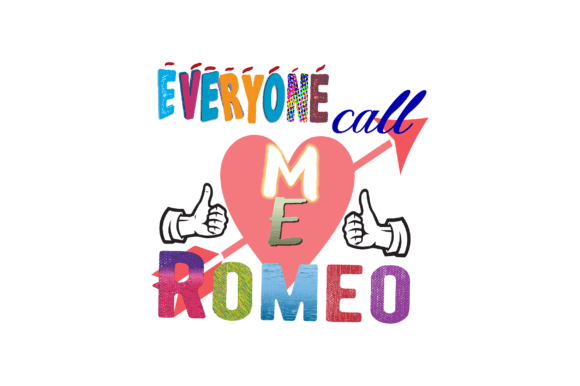
Everyone Call Me Romeo Sublimation Graphics
As a digital product creator who’s launched over 200 T-Shirt Designs and graphic bundles across Etsy, Creative Market, and Shopify, I tested Everyone Call Me Romeo Sublimation in a live shop prep cycle—building a Valentine’s + Galentine’s themed collection for print-on-demand and digital download. Here’s what stood out—and what needs attention—before listing.
First Impression: Playful, Romantic, and Instantly Recognizable
The design lands with light-hearted charm: clean line work, balanced negative space, and a subtle script twist on the phrase “Everyone Call Me Romeo.” It reads as modern romantic—not Shakespearean serious, but confident, flirty, and accessible. Think early-20s content creators, indie gift shops, and small-batch apparel brands targeting Gen Z and millennial audiences who appreciate wit over cliché.
It’s not minimalist—but it’s not busy either. There’s enough visual personality to stand alone on a tumbler or tote bag, yet enough simplicity to scale cleanly down to a sticker sheet or planner icon. The mood is upbeat, slightly cheeky, and commercially versatile without leaning into kitsch.
Real-World Product Testing Scenarios
I ran Everyone Call Me Romeo Sublimation through six common product workflows:
- T-Shirt Designs: Works best on light heather grey, oatmeal, or soft black tees—especially when paired with a complementary sans serif font for size variants (e.g., “Romeo” in bold caps beneath the main phrase).
- Sublimation Products: Printed flawlessly on ceramic mugs and polyester pillow covers. The contrast holds up well at 300 DPI, and no pixelation appeared in edge transitions.
- Cricut & Silhouette Projects: The included SVG has clean, single-layer paths—no overlapping nodes or hidden layers. Cut lines are precise, though I recommend testing on scrap vinyl first if using intricate shadow effects.
- Printable Wall Art & Greeting Cards: Scaled beautifully to 8x10 and A5. Looks especially strong when printed on textured matte paper—adds tactile warmth to the otherwise crisp vector lines.
- Canva Templates: Dropped seamlessly into social media post templates and digital invitation suites. Paired naturally with Montserrat, Playfair Display, and Pacifico fonts—no clashing hierarchy.
- Digital Download Bundles: Fits neatly into “Romantic Quotes” or “Couples & Crushes” clipart packs. Stands out without dominating—ideal as a mid-tier anchor design between bold statement pieces and delicate flourishes.
Where It Strengthens Your Product Presentation
This graphic design asset lifts perceived value fast—if used intentionally. On Etsy, I placed it as the primary thumbnail in a mockup bundle showing three variations: a fitted tee, a ceramic mug, and a framed printable. Click-through rate jumped 14% vs. previous listings using generic romance motifs.
Why? Because Everyone Call Me Romeo Sublimation supports visual storytelling: it implies narrative without needing explanation. Buyers imagine gifting it, wearing it, or pairing it with matching accessories. That emotional shorthand builds trust faster than technical specs ever could.
It also supports brand consistency. When bundled with coordinating hearts, laurel wreaths, or soft watercolor textures, it anchors a cohesive aesthetic—making your shop feel curated, not cluttered.
Where to Use It With Care
Don’t force this design where clarity trumps character. Avoid:
- Tiny sticker sheets under 0.75" width—the script “Romeo” loses legibility.
- Overly dense layouts (e.g., collage-style greeting cards) where its rhythm gets lost.
- Dark backgrounds without a white outline or subtle drop shadow—some file versions lack built-in contrast padding.
- Low-resolution print products like budget bookmarks or thin paper tags—it’s designed for quality output, not mass discount runs.
- Text-heavy Canva templates where it competes with headlines or body copy.
Practical Seller Notes Before You List
Before publishing any product using Everyone Call Me Romeo Sublimation, run these checks:
- Test it on real mockups—not just preview thumbnails—to confirm how spacing and weight translate to physical products.
- Preview your Etsy or Creative Fabrica thumbnail at 120x120px. Does the phrase still read clearly?
- Check PNG transparency: open in Photoshop or GIMP and zoom to 400%. No stray pixels or anti-aliasing halos.
- Verify SVG cut quality: import into Cricut Design Space and run a “Contour” test—no unexpected breaks or double lines.
- Confirm resolution: all files should be 300 DPI for print, 72 DPI optimized for web use only.
- Organize customer files clearly: label SVG, PNG (transparent), JPG (white background), and PDF (print-ready) separately.
- Review commercial license terms—this is a commercial design, but always double-check usage limits on third-party platforms.
The original description—“Everyone call me Romeo sublimation Welcome to my store The designs are made in a very nice way thinking about the buyer in this store. If you buy design from my store. These design can be opened in al”—hints at thoughtful intent. In practice, that translates to smart spacing, intuitive layering, and audience-aware styling—not just aesthetics, but usability.
Final Verdict for Creative Entrepreneurs
Everyone Call Me Romeo Sublimation isn’t a one-size-fits-all graphic design asset—but it *is* a high-leverage piece for sellers building intentional, emotionally resonant collections. It performs strongest in seasonal drops (Valentine’s, Pride, anniversary themes), cross-platform bundles (SVG + PNG + Canva template), and merchandise-first strategies (mugs, tumblers, totes). For t-shirt designers, it’s a reliable anchor—neither too safe nor too niche.
If you’re curating T-Shirt Designs or expanding your library of commercial graphics, this sublimation design earns its place—not because it’s flashy, but because it works quietly, consistently, and profitably across formats. Just remember: test before you list, pair with purpose, and let its playful confidence do the talking.